
Imagine you are standing at a crossroads on a foggy morning. You can barely see ten feet in front of you, yet you have to decide whether to take a massive leap forward or stay put. For most of us, that sounds like a nightmare. But for global corporations, this is just another Tuesday. When the economic landscape is shaky, political tensions are high, and supply chains are fragile, the instinct for many leaders is to freeze. They wait for the sun to come out before making a move. However, some of the biggest players in the game are doing the exact opposite. They are striking deals in the thickest part of the fog.
- Why Big Business Doesn’t Wait for Perfect Weather
- Decoding the Message Behind the Chevron Move
- How You Can Apply This Mindset to Your Own Ventures
- 1. Look for Value in Fear
- 2. Build Flexible Partnerships
- 3. Do Your Homework (Then Trust Your Gut)
- 4. Diversify Your Risk
- Turning Uncertainty Into Your Advantage
The recent developments surrounding the Chevron-Venezuela Deal Signals a major shift in how giants approach risk. It tells us that waiting for “perfect” conditions might mean missing the boat entirely. Instead of hiding away, smart companies are learning to navigate uncertainty with calculated boldness. This isn’t about gambling; it’s about understanding that huge rewards often hide behind the scariest doors. If you run a business, manage investments, or simply want to understand where the global economy is heading, paying attention to these moves is essential.
In this article, we will break down what is really happening beneath the headlines. We aren’t here to drown you in legal jargon or complex geopolitical analysis. Instead, we will look at the human logic behind these high-stakes decisions. We will explore why corporate deal-making is heating up even when the news cycle feels doom-laden, and what lessons you can apply to your own financial and professional life. By understanding the strategy behind the Chevron move, you can learn to spot opportunities where others only see danger.
Why Big Business Doesn’t Wait for Perfect Weather
It is easy to think that billionaires and CEOs have crystal balls. We imagine they know exactly what will happen next year, so they make their moves with total confidence. The truth is much more relatable: they are just as unsure as you are. The difference lies in how they handle that uncertainty.
When markets are volatile, fear tends to paralyze average investors and small business owners. We worry about inflation, elections, or wars, so we hoard cash and delay expansion. But large corporations operate on a different timeline. They know that if they wait until everything is safe, the opportunity will be gone, or the price will be triple what it is today. The Chevron-Venezuela Deal Signals that top-tier leaders are willing to accept short-term chaos for long-term gain.
The Cost of Waiting
Think about the last time you hesitated on a big decision because you were waiting for the “right time.” Maybe you waited to buy a house, start a side hustle, or invest in a new skill. Often, by the time you felt ready, the window had closed. In the corporate world, this hesitation can cost billions. When competitors are securing resources and locking in partnerships during a downturn, the companies that sit still get left behind.
Uncertainty actually creates value. When everyone else is selling or pulling back, assets become cheaper. Relationships become more valuable because trust is scarce. By stepping in when others are stepping out, companies like Chevron can negotiate better terms and secure a stronger position for the future. It is the classic advice of “buy low, sell high,” but applied to entire nations and industries.
Decoding the Message Behind the Chevron Move
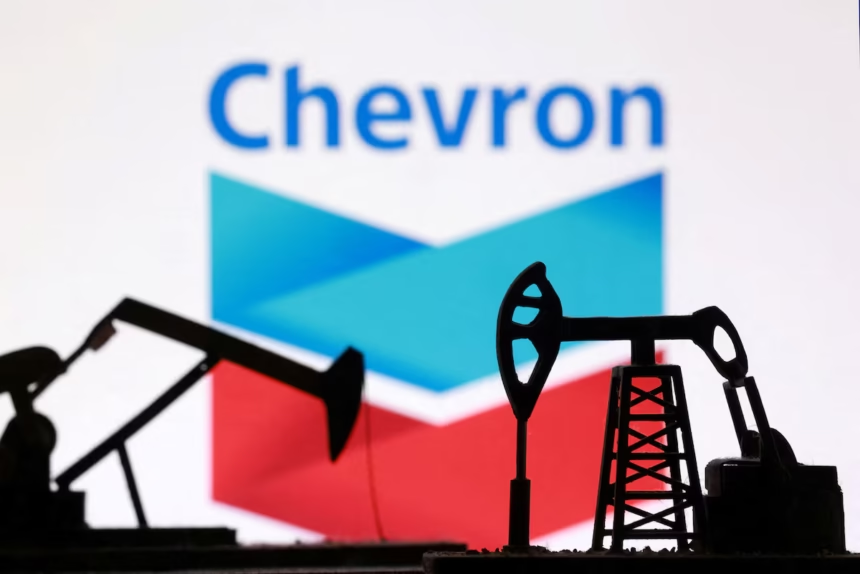
So, what exactly is the Chevron-Venezuela Deal Signals to the rest of the market? On the surface, it looks like a simple oil agreement. But if you peel back the layers, it is a masterclass in strategic patience and diplomatic maneuvering. Venezuela has one of the largest oil reserves on the planet, but years of sanctions and political instability made it a “no-go zone” for many Western companies.
For Chevron to re-enter this space, even cautiously, sends a powerful message: the calculus of risk has changed. It suggests that the potential upside of accessing those vast resources now outweighs the dangers of the current political climate. It tells other executives that engagement is possible, even with difficult partners, if the structure of the deal is right.
Navigating Geopolitical Minefields
This kind of corporate deal-making requires a delicate touch. It isn’t just about signing a contract; it is about navigating a web of international relations, legal restrictions, and public perception. Chevron didn’t just rush in; they worked within specific licenses granted by the US government, showing that they are aligning their business goals with broader geopolitical shifts.
This teaches us an important lesson about agility. The rules of the game can change overnight. A sanction can be lifted; a trade war can end; a new administration can take power. Companies that maintain relationships and keep a foot in the door, even tentatively, are ready to sprint when the gate opens. Those that completely cut ties might find themselves locked out for years. The Chevron-Venezuela Deal Signals that maintaining a presence in uncertain markets is a strategy in itself.
Long-Term Vision Over Short-Term Noise
Another key takeaway is the focus on decades, not quarters. Oil projects take years to yield results. The decisions made today won’t impact the bottom line until well into the next decade. This long-term perspective allows leaders to ignore the daily noise of the stock market and the 24-hour news cycle.
If you are running your own life or business, try to adopt this mindset. Are you making decisions based on next week’s headlines, or where you want to be in ten years? Uncertainty is almost always temporary. Resources, strategic locations, and talented partners are permanent needs. Prioritizing the long view helps you see past the immediate fog.
How You Can Apply This Mindset to Your Own Ventures
You might be thinking, “That’s great for a multi-national oil giant, but I’m just trying to grow my small business or manage my retirement fund.” The scale is different, but the principles of corporate deal-making in uncertain times are surprisingly universal. You don’t need to negotiate with governments to use these strategies.
1. Look for Value in Fear
When your industry is facing a downturn, look around. Who is struggling? Who is selling off assets cheaply? Is there a competitor who is losing customers because they panicked and cut quality? This is your moment to shine. You might not be able to buy a rival company, but you can hire their best talent, acquire their former clients, or invest in marketing while costs are low. The Chevron-Venezuela Deal Signals that the biggest prizes go to those who show up when the party seems over.
2. Build Flexible Partnerships
In stable times, you might sign rigid, long-term contracts. In uncertain times, flexibility is king. Look for deals that allow you to pivot. Maybe it’s a supplier who agrees to smaller, more frequent orders rather than a massive bulk buy. Maybe it’s a partnership where both parties share the risk. The goal is to stay in the game without betting the farm on a single outcome.
3. Do Your Homework (Then Trust Your Gut)
Chevron didn’t walk into Venezuela blindly. They spent years analyzing the geology, the politics, and the legal frameworks. Before you make a bold move, gather as much data as you can. Talk to mentors, read the reports, and understand the risks. But eventually, you have to accept that you will never have 100% of the information. At some point, you have to trust your preparation and take the leap. Paralysis by analysis is the enemy of growth.
4. Diversify Your Risk
Even with a bold move, you never put all your eggs in one basket. Large corporations balance risky ventures in unstable regions with safe, steady income streams elsewhere. Ensure your personal finances or business portfolio has a solid foundation. This safety net gives you the confidence to take calculated risks in areas with high potential rewards.
Turning Uncertainty Into Your Advantage
The world is rarely predictable. There will always be elections, market crashes, pandemics, and conflicts. If you wait for a calm sea to set sail, you will never leave the harbor. The story of Chevron and Venezuela is a reminder that progress often happens in the messy, complicated middle.
By observing what the Chevron-Venezuela Deal Signals, we learn that uncertainty is not a stop sign; it is a filter. It filters out the timid and the unprepared, leaving the field open for those who are brave enough to engage. Whether you are negotiating a salary, launching a product, or investing your savings, remember that the best opportunities often come wrapped in worry.
Don’t let the fog scare you into inaction. Use it as cover to make the moves that your competitors are too afraid to attempt. Prepare thoroughly, keep your long-term vision clear, and be willing to step forward when others step back. The future belongs to those who build it, rain or shine. So, take a deep breath, assess your options, and get ready to make your own mark, even in uncertain times. You have more power to shape your destiny than you think.