
Imagine you are running a small but growing online store. It’s 2:00 AM on a Tuesday, and your phone buzzes with an order notification from a customer in Tokyo. Ten minutes later, another message pops up asking about a shipping delay. Then comes a question about a product return. In the past, you would have had to wait until morning to answer, risking frustrated customers and negative reviews. But now, you roll over and go back to sleep. Why? Because your AI customer support agents are already handling these queries, resolving issues, and keeping your clients happy while you dream.
This scenario is becoming the new normal for businesses of all sizes. There is a lot of noise and fear surrounding artificial intelligence right now. Headlines scream that robots are coming for our jobs, and it’s easy to worry that the human touch in business is disappearing forever. But the reality on the ground is much more nuanced and, frankly, much more hopeful. We aren’t seeing a mass replacement of people; we are seeing a massive upgrade in how teams work.
In this article, we are going to cut through the hype and look at what is actually happening in support departments everywhere. We will explore how AI customer support agents are changing the game, why they are better at some things than humans (and terrible at others), and how you can use this technology to build a better, more empathetic business without losing your soul. Whether you are a solo entrepreneur or managing a large team, understanding this balance is key to thriving in the modern market.
The Real Job of an AI Agent
First, let’s clear up a common misconception. When we talk about AI customer support agents, we aren’t talking about those clunky chatbots from ten years ago that could only say, “I didn’t understand that.” Those were frustrating tools that made customers want to throw their phones across the room.
Modern AI agents are different. They are powered by advanced language models that can read, understand context, and even detect emotion. They can access your knowledge base, check order statuses, process returns, and answer complex questions in seconds. Their primary job isn’t to be “human”; it’s to be efficient. They handle the repetitive, high-volume tasks that often burn out human employees.
Handling the “Boring” Stuff
Think about the types of questions your business gets every day. “Where is my package?” “What are your opening hours?” “How do I reset my password?” These are important questions, but they are also repetitive. Answering them hundreds of times a day can make a human support rep feel like a robot. By handing these tasks over to AI customer support agents, you free up your human team to focus on problems that actually require creativity, empathy, and critical thinking.
For a business, this shift is transformative. It means you can offer 24/7 support without needing to hire three shifts of staff. It means your customers get instant answers instead of waiting on hold for forty-five minutes. The AI acts as the first line of defense, solving the easy stuff instantly and only passing the tough cases to a human when necessary.
Where Humans Still Reign Supreme
If AI is so fast and smart, why do we still need people? The answer lies in the one thing algorithms cannot replicate: genuine emotional connection. There are moments in customer service where a script, no matter how well-written, just won’t cut it.
The Empathy Gap
Imagine a customer who has been waiting two weeks for a crucial delivery that was supposed to arrive on time. They are stressed, angry, and maybe even crying. An AI agent can apologize, offer a refund, and expedite a new shipment based on your rules. And technically, that solves the problem. But it doesn’t heal the relationship.
A human agent can hear the tremor in the customer’s voice (or read the frustration in their typing). They can say, “I am so sorry this happened. I know how stressful this must be for you, especially with your deadline. Let me personally make sure this gets fixed right now.” That moment of shared humanity changes everything. It turns an angry critic into a loyal fan. AI customer support agents simply cannot feel empathy, and customers can tell the difference.
Navigating Complex, Unique Scenarios
Business is messy. Sometimes, a customer’s problem doesn’t fit into a neat category. Maybe they have a unique combination of issues, or perhaps there is a nuance in their situation that requires judgment calls outside of standard operating procedures. Humans excel at connecting dots that seem unrelated. They can use intuition and experience to find creative solutions that an AI, which relies on patterns from the past, might miss.
When a situation is ambiguous or highly sensitive, the human touch is not just a luxury; it is a necessity. This is why the most successful companies are using AI to augment their teams, not replace them. The AI handles the volume; the humans handle the value.
The Hybrid Model: The Best of Both Worlds
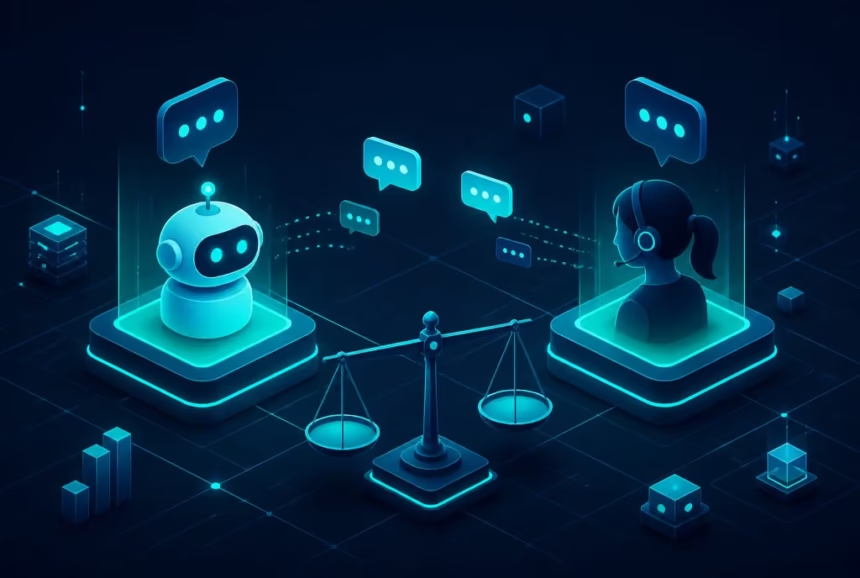
So, if AI isn’t replacing humans, what is the future looking like? The answer is the hybrid model. This approach combines the speed and scalability of technology with the warmth and ingenuity of people. It is about creating a seamless handoff where the customer barely notices the transition between bot and human.
How It Works in Practice
In a well-designed hybrid system, the interaction starts with an AI customer support agent. The AI greets the customer, identifies the issue, and attempts to solve it immediately. If the AI detects that the customer is getting frustrated, or if the problem is too complex, it instantly escalates the ticket to a human agent.
Crucially, the AI passes along all the context. The human agent doesn’t have to ask, “What is your order number?” or “What have we tried so far?” They already know. The AI provides a summary: “Customer is upset about late delivery #12345. I offered a refund, but they requested a replacement instead due to urgency.” This allows the human to jump straight into solving the problem with empathy, rather than wasting time on data gathering.
Benefits for Your Business
Adopting this model offers incredible advantages for any business:
- Cost Efficiency: You reduce the cost per ticket by automating the simple queries, allowing you to scale your support without linearly increasing your headcount.
- Employee Satisfaction: Your support team stops doing the boring, repetitive work that leads to burnout. Instead, they spend their day solving interesting problems and helping people in meaningful ways. Happy employees stay longer and perform better.
- Customer Satisfaction: Customers get the best of both worlds: instant responses for simple issues and deep, empathetic help for complex ones. No one likes waiting, and no one likes talking to a robot when they are upset. The hybrid model gives them exactly what they need, when they need it.
Preparing Your Team for the Shift
If you are worried that bringing in AI customer support agents will cause panic among your staff, you are not alone. Change is scary. However, the narrative shouldn’t be about replacement; it should be about elevation. Your team members are not being fired; they are being promoted to higher-value roles.
Reskilling and Upskilling
The introduction of AI is a perfect opportunity to invest in your people. Train your support reps to become “customer experience specialists.” Teach them how to manage the AI tools, how to interpret the data the AI provides, and how to handle high-level conflict resolution. Encourage them to focus on building relationships and gathering insights that can improve your product.
When employees see that the technology is there to make their jobs easier—not to take them away—their attitude shifts. They start to view the AI as a helpful assistant rather than a competitor. This cultural shift is essential for successful implementation.
Setting Clear Boundaries
It is also important to define clearly what the AI should and should not do. Create guidelines that protect the human element of your brand. For example, decide that any complaint involving legal threats, severe emotional distress, or VIP clients goes straight to a human. By setting these boundaries, you ensure that your brand’s values remain intact even as you automate processes.
Embracing the Future of Support
The question “Are AI customer support agents replacing human reps?” has a simple answer: No, but they are definitely changing what it means to be a support rep. The era of humans acting as walking FAQs is over. The era of humans acting as trusted advisors, problem solvers, and brand ambassadors is just beginning.
Technology is a powerful tool, but it is just that a tool. It cannot care about your customers. It cannot build a community. It cannot understand the subtle nuances of human emotion. Those qualities are yours, and they are what make your business special. By letting AI handle the heavy lifting of data and repetition, you are actually freeing yourself to be more human than ever before.
So, don’t fear the rise of the machines. Welcome them as your newest teammates. Use them to clear the clutter so you can focus on what really matters: connecting with people. If you approach this transition with optimism and a clear strategy, you will find that your customer support becomes faster, smarter, and surprisingly more personal. The future of business isn’t about choosing between humans and AI; it’s about bringing them together to create something extraordinary. You have the power to lead that change, starting today.