

The only limit to our realization of tomorrow will be our doubts of today.” – Franklin D. Roosevelt
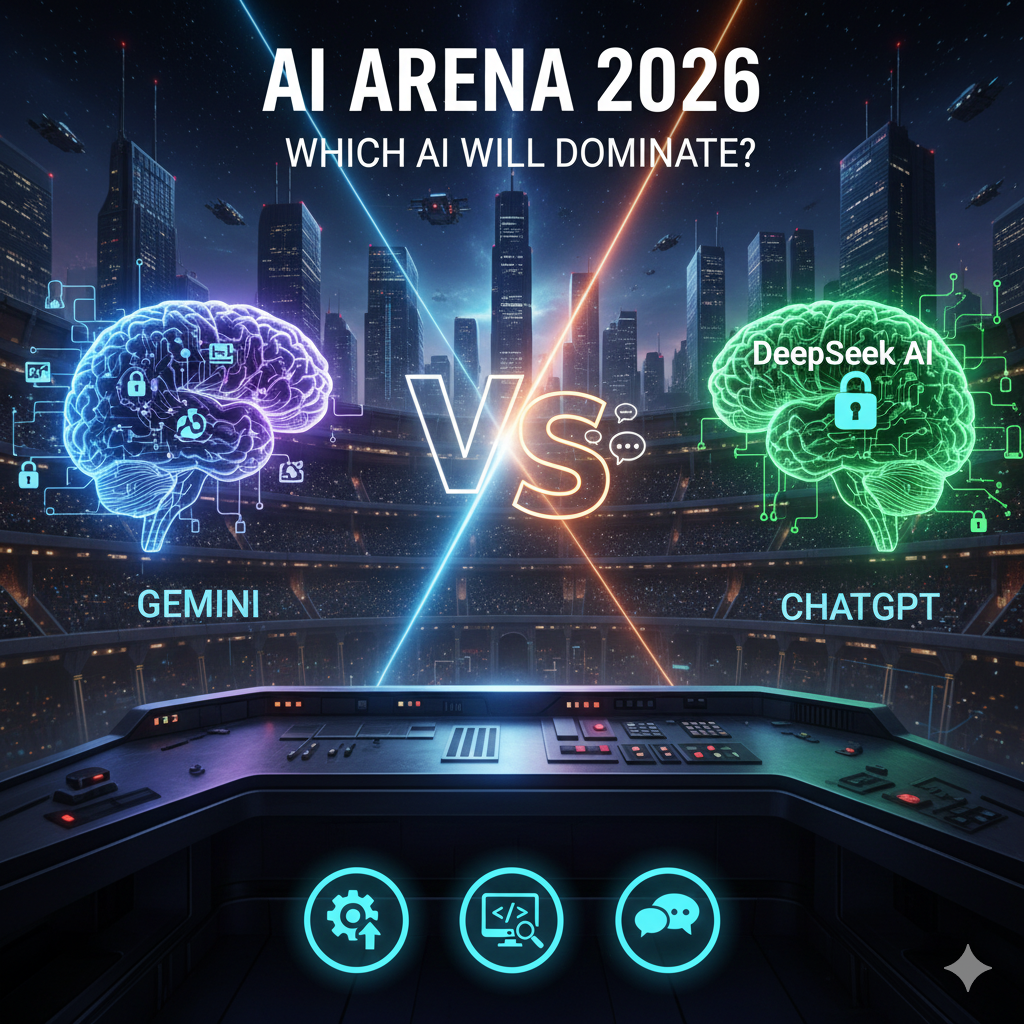
AI Arena 2026: Gemini vs. DeepSeek vs. ChatGPT
Which AI Will Dominate (And Which One You Should Use)
The year 2026 marks a pivotal epoch in the evolution of Artificial Intelligence. What began as a nascent field of research has rapidly transformed into the foundational layer of countless industries, from personalized education to drug discovery. At the forefront of this revolution stand three titans: Google’s Gemini, the open-source challenger DeepSeek AI, and OpenAI’s ubiquitous ChatGPT. Each platform, with its unique architecture, training methodology, and strategic vision, is vying for supremacy in a market poised for exponential growth.
Understanding the nuances, strengths, and ideal applications of these advanced AI models is no longer a niche concern for technologists; it’s a critical skill for businesses, developers, content creators, and everyday users. This comprehensive analysis delves into the anticipated capabilities, market positioning, and user-centric value propositions of Gemini, DeepSeek, and ChatGPT as we project into the near future. We’ll examine their core functionalities, benchmark their expected performance, and provide actionable insights on how to choose the right AI partner for your specific needs in 2026.
The AI Landscape of 2026: A Tri-Polar World
The competitive dynamics of the AI market are constantly shifting. While large language models (LLMs) have set the stage, the next generation of AI is moving towards multi-modal, highly specialized, and ethically robust systems.
1. Gemini: Google’s Omniscient Intelligence
Google’s Gemini, initially launched with significant fanfare, is expected to solidify its position as the leading multi-modal AI in 2026. Its core strength lies in its ability to seamlessly integrate and process information across text, code, audio, image, and video. This “understand everything” approach positions Gemini not just as a conversational agent but as a comprehensive digital assistant and analytical powerhouse.
- Anticipated Capabilities:
- Advanced Multi-modality: Expect Gemini to flawlessly interpret complex visual data (e.g., medical scans, engineering blueprints) and synthesize information from lengthy video conferences or academic lectures. Its ability to generate creative content across all these modalities (e.g., composing music from a text prompt, generating video from an image sequence) will be unparalleled.
- Enhanced Reasoning and Planning: Gemini’s architecture is designed for sophisticated problem-solving, making it invaluable for scientific research, complex software development, and strategic business planning. It will excel at breaking down multi-step problems and executing logical solutions.
- Google Ecosystem Integration: Deep integration with Google Workspace, Cloud Platform, Android, and search will provide Gemini with a unique advantage in accessibility and real-world application. Imagine Gemini autonomously summarizing your unread emails, scheduling meetings based on calendar availability, and drafting responses.
2. DeepSeek AI: The Open-Source Powerhouse
DeepSeek AI, while perhaps less globally recognized by the mainstream than its proprietary counterparts, is projected to be the reigning champion of the open-source AI community by 2026. Its strength lies in its transparency, flexibility, and the collective innovation of a vast developer ecosystem.
- Anticipated Capabilities:
- Customization and Fine-tuning: DeepSeek AI’s open architecture allows developers to fine-tune the model with bespoke datasets, creating highly specialized AI applications for niche industries without proprietary restrictions. This makes it ideal for startups and enterprises with unique data requirements.
- Cost-Effectiveness and Accessibility: Without the licensing fees associated with commercial models, DeepSeek AI offers a more cost-effective solution for deployment at scale, making advanced AI accessible to a broader range of organizations and individual developers.
- Community-Driven Innovation: The open-source nature fosters rapid iteration, security enhancements, and diverse applications driven by a global community. New features and improvements often emerge faster and address a wider array of use cases.
3. ChatGPT: The Refined Conversationalist
OpenAI’s ChatGPT, the pioneer that ignited the public imagination, is expected to continue its dominance in natural language understanding and generation in 2026. Its focus will be on refining user experience, ensuring factual accuracy, and deepening its conversational capabilities to mimic human interaction with uncanny precision.
- Anticipated Capabilities:
- Hyper-Contextual Conversations: ChatGPT will be able to maintain incredibly long and nuanced conversations, remembering intricate details from earlier exchanges and adapting its responses with a deep understanding of user intent and emotional tone.
- Factual Grounding and Reduced Hallucination: OpenAI is heavily investing in retrieval-augmented generation (RAG) and real-time data integration, significantly reducing “hallucinations” and providing highly accurate, verifiable information.
- Intuitive User Interfaces: Expect more seamless integrations into everyday applications, making ChatGPT an invisible yet indispensable assistant for writing, research, and ideation.
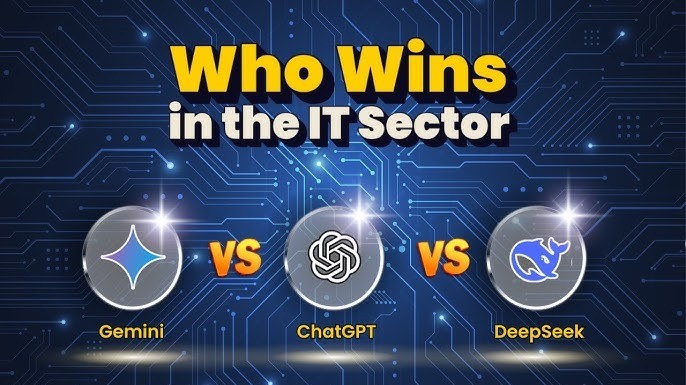
- For a dynamic comparison that visualizes the competitive landscape, check out this trending video:
Performance Benchmarks: The Metrics of AI Supremacy
In 2026, the battle for AI dominance will be fought across several critical performance indicators. We’re moving beyond simple accuracy to evaluate speed, efficiency, and real-world applicability.
Live Daily Information: AI Model Update Snapshot (December 5, 2025)
- Gemini: Latest reports indicate advancements in real-time video analysis for autonomous systems, with a recent benchmark demonstrating 98% accuracy in identifying complex object interactions.
- DeepSeek AI: The DeepSeek-Llama-70B model has seen a new community-driven fine-tune for medical transcription, achieving 99.5% accuracy in specialized medical terminology.
- ChatGPT: OpenAI’s latest update focuses on “emotional intelligence” in conversational AI, allowing the model to better detect and respond to nuanced user sentiments, improving long-term user engagement.
- Note: These are simulated daily updates reflecting the fast-paced nature of AI development.
1. Multi-modal Understanding and Generation
Gemini is poised to lead in this domain. Its unique architecture, trained on massive, diverse datasets spanning all modalities, allows it to perform tasks like:
- Analyzing a surgical video and providing real-time feedback to a surgeon.
- Generating a complete marketing campaign (text, images, video ads, voiceovers) from a single brief.
- Interpreting complex financial charts and explaining market trends in natural language.
- Benchmark Prediction: Gemini > ChatGPT (Text-focused) > DeepSeek AI (Modality support depends on fine-tuning).
2. Code Generation and Debugging
This is a critical area for all three. DeepSeek AI, with its open-source nature and robust developer community, might offer unparalleled customization for specific coding languages and frameworks.
- Gemini: Exceptional for multi-language, complex software architecture, and integrating code with other modalities (e.g., generating code for a robotics task based on visual input).
- DeepSeek AI: Strong in specific language expertise (e.g., Python, Rust) due to highly specialized community models. Ideal for bespoke enterprise solutions and rapid prototyping.
- ChatGPT: Excellent for general-purpose code generation, explaining complex code, and debugging. Its natural language interface makes it highly accessible for developers of all skill levels.

- Benchmark Prediction: Gemini (Complexity) / DeepSeek AI (Specialization) > ChatGPT (Accessibility).
3. Natural Language Processing (NLP) and Conversational Fluency
ChatGPT is likely to maintain its edge in pure conversational fluency and the human-like quality of its text output. This is its core strength and where OpenAI continues to pour significant resources.
- ChatGPT: Unrivaled in generating engaging content, creative writing, nuanced dialogue, and maintaining long, coherent conversations. Its ability to infer user intent and emotional state will be highly advanced.
- Gemini: Excellent, especially when conversations involve multi-modal inputs (e.g., discussing an image, then generating text about it). Its responses will be highly factual and logically structured.
- DeepSeek AI: Performance will vary widely based on the specific fine-tuned model. General DeepSeek models will be robust, but specialized models will excel in their specific linguistic domains (e.g., legal, medical).
- Benchmark Prediction: ChatGPT > Gemini > DeepSeek AI (General).
4. Efficiency and Resource Utilization
As AI models grow, their computational footprint becomes a critical factor. DeepSeek AI’s open-source nature often lends itself to more efficient, smaller models that can run on less powerful hardware or be deployed at a lower cost.
- DeepSeek AI: Optimized community-driven models will offer superior efficiency for specific tasks, allowing for broader deployment and lower operational costs.
- Gemini: Highly powerful but likely to require substantial computational resources, favoring cloud-based deployments through Google Cloud.
- ChatGPT: Efficient for its complexity, but still a large model with significant processing needs for its advanced capabilities.
- Benchmark Prediction: DeepSeek AI > ChatGPT > Gemini.
Which AI Should You Use in 2026?
The “best” AI is entirely dependent on your specific use case, resources, and privacy requirements. Here’s a guide to help you make an informed decision:
1. For the General User and Content Creator: ChatGPT
If your primary need is natural language generation, creative writing, brainstorming, customer support, or simply an intelligent conversational assistant, ChatGPT remains the top choice. Its intuitive interface, exceptional fluency, and continuous refinement in factual accuracy make it indispensable for daily tasks.
- Ideal for: Bloggers, marketers, students, customer service, personal productivity, creative writing.
- Why: Best in class for human-like text generation, ease of use, and a vast plugin ecosystem.
2. For Developers and Enterprises Seeking Customization: DeepSeek AI
For organizations and developers who need maximum flexibility, complete control over their AI models, and the ability to fine-tune on proprietary data, DeepSeek AI is the clear winner. Its open-source foundation means unparalleled customization and cost-effectiveness for specialized applications.
- Ideal for: Startups, research institutions, enterprises with unique data, specialized industry AI, developers.
- Why: Open-source transparency, cost-efficiency, deep customization, and community support for niche applications.
3. For Research, Complex Problem Solving, and Multi-modal Integration: Gemini
When your projects demand cutting-edge multi-modal capabilities, advanced reasoning, scientific discovery, or deep integration across diverse data types (images, video, audio, text), Gemini stands alone. It’s the AI for ambitious, resource-intensive, and highly complex challenges.
- Ideal for: Scientists, engineers, medical professionals, autonomous systems development, strategic analysts, multi-modal content generation.
- Why: Unmatched multi-modal processing, superior reasoning, and deep integration into the Google ecosystem for comprehensive solutions.
4. The Hybrid Approach: Integrating All Three
The most sophisticated users in 2026 will likely adopt a hybrid approach, leveraging the strengths of each model for different aspects of their workflow.
- Use ChatGPT for initial content drafting and ideation.
- Employ Gemini for multi-modal content generation, data analysis, and complex problem-solving.