
Imagine you are sitting at a café in Lisbon, the sun warming your back, watching the trams rattle by. You have your laptop open, but instead of frantically clicking between spreadsheets, email inboxes, and project management dashboards, you are simply sipping your coffee. A quiet notification pops up: “Trip itinerary finalized, expenses logged, and client report sent.” You didn’t spend hours manually moving data from one app to another. You didn’t even write a single line of code. You just asked for it.
This isn’t a distant fantasy reserved for tech giants with massive IT departments. It is happening right now, and it is changing how we work while we travel. For years, we have been told that running a business or managing a complex project requires a stack of expensive, clunky business software that takes months to learn. But the landscape is shifting rapidly. We are witnessing a moment where AI agents replacing business software is becoming the new normal, freeing up your time to focus on what actually matters: living your life and exploring the world.
In this article, we will break down exactly what this shift means for you. We will explore how these intelligent digital helpers work, why they are perfect for the modern traveler or remote worker, and how you can start building your own “no-code” workflows today without needing a computer science degree. Whether you are planning your next gap year or running a startup from a van, understanding this technology could be the key to true freedom.
What Exactly Are AI Agents?
Before we get into the nitty-gritty of how this changes your daily routine, let’s clear up some confusion. You have probably heard the term “AI” thrown around a lot lately. Usually, people think of chatbots that answer questions or image generators that create art. Those are helpful, but they are passive. You ask, they answer. You stop asking, they stop working.
AI agents are different. Think of them as proactive digital employees rather than just smart search engines. While a standard tool waits for your command, an agent can perceive its environment, make decisions, and take action across multiple platforms to achieve a goal.
For example, if you tell a traditional program to “book a flight,” it might open a browser window for you to fill out. If you tell an AI agent to “book the cheapest flight to Tokyo next Tuesday under $800 and add it to my calendar,” it will search airlines, compare prices, select the best option, complete the booking, and update your schedule—all on its own. This capability is the driving force behind the trend of AI agents replacing business software that used to require human hands on every single button.
The Shift from Tools to Teammates
The old way of working relied on you being the glue holding everything together. You were the one copying data from your email to your spreadsheet, then pasting it into your invoicing system. You were the integrator.
With agents, the dynamic flips. These systems act as teammates. They don’t just store information; they process it. They can read an invoice attached to an email, extract the total amount and due date, check your bank balance, schedule the payment, and file the receipt in your tax folder. This level of automation means the rigid, siloed business software of the past is becoming less relevant. Instead of buying ten different subscriptions that barely talk to each other, you are starting to rely on a few flexible agents that can do the work of all ten.
Why Travelers and Remote Workers Are Leading the Charge
You might wonder why this topic is appearing in our Travel section. The connection is simple: freedom. The biggest barrier to long-term travel or a location-independent lifestyle has never been the desire to see the world; it has been the fear of dropping the ball on work.
When you are hopping between time zones, dealing with spotty Wi-Fi in a hostel in Bali, or trying to enjoy a sunset in Santorini without your phone buzzing every five minutes, you need systems that run themselves. You cannot afford to be tied to a desk because a specific piece of software requires a manual update or a complex login sequence.
The “No-Code” Revolution
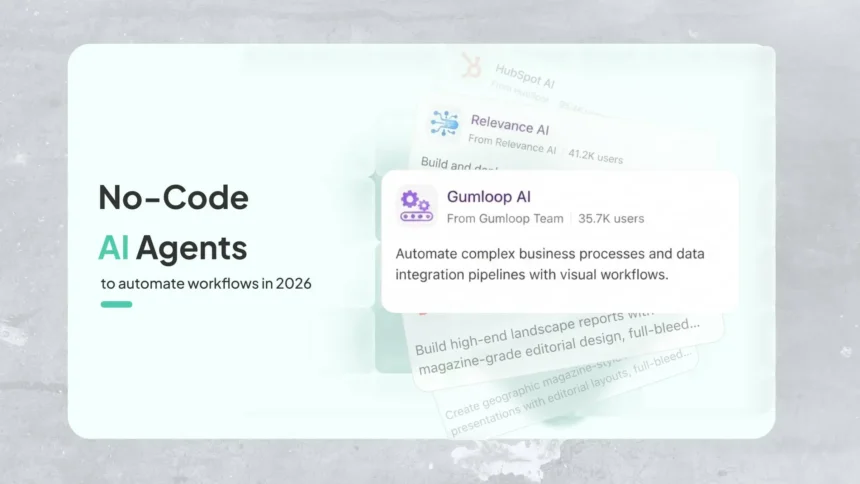
Here is the best part: you do not need to be a coder to set this up. In the past, automating these tasks required hiring developers to write custom scripts or buying enterprise-level integration tools that cost thousands of dollars a month. Today, we are in the era of no-code AI workflows.
“No-code” simply means using visual interfaces like dragging and dropping blocks to build complex automations. It is like building with digital Legos. You connect a block that says “When I receive an email with an attachment” to a block that says “Use AI to summarize the attachment” and finally to a block that says “Post the summary to Slack.”
This accessibility is fueling the boom of AI agents replacing business software. Small business owners, solo entrepreneurs, and digital nomads can now build sophisticated operational systems in an afternoon. You can create a workflow that handles your customer service inquiries while you are hiking the Andes, or one that manages your social media posting schedule while you are learning to surf in Costa Rica.
Real-Life Examples for the Modern Nomad
Let’s look at how this plays out in real scenarios for someone on the road:
- Expense Tracking: Instead of saving every receipt and entering it into an accounting app at the end of the month, an agent can monitor your email for purchase confirmations, categorize the spending based on your rules, convert currencies automatically, and update your budget sheet in real-time.
- Client Onboarding: When a new client signs a contract, an agent can instantly generate a welcome packet, set up a shared project folder, send an introductory email, and schedule the kickoff meeting based on both your calendars, regardless of time zone differences.
- Travel Planning: Rather than spending hours on twenty different tabs comparing hotels and flights, you can deploy an agent to scan hundreds of options based on your specific criteria (e.g., “must have fast Wi-Fi and be near a gym”), present you with the top three choices, and book the one you pick.
These aren’t just time-savers; they are sanity-savers. They allow you to be present in the moment, knowing that the backend of your life and business is being handled competently.
How to Start Building Your Own No-Code Workflows
If you are feeling intrigued but slightly overwhelmed, take a deep breath. Getting started is much easier than it sounds. You do not need to overhaul your entire life overnight. The key is to start small and solve one specific pain point.
Step 1: Identify the Repetitive Task
Look at your day. What is the one task you dread doing? Is it sorting through emails? Updating a spreadsheet? Chasing clients for payments? That repetitive, boring task is the perfect candidate for an AI agent. If you find yourself doing the same series of clicks more than three times a week, it can likely be automated.
Step 2: Choose a User-Friendly Platform
There are several powerful platforms designed specifically for non-technical users. Tools like Zapier, Make (formerly Integromat), and newer AI-native platforms allow you to connect apps visually. Many of these now have built-in AI capabilities where you can simply type what you want in plain English, and the platform builds the workflow for you.
Step 3: Define the Goal Clearly
When setting up your agent, be specific about the outcome. Instead of saying “help with emails,” try “read incoming emails from clients, summarize the main request, and draft a reply asking for a meeting time.” The clearer your instructions, the better your agent will perform. Remember, AI agents replacing business software works best when the logic is straightforward and the goals are well-defined.
Step 4: Test and Iterate
Run your new workflow with a small batch of data first. See how it behaves. Did it miss something? Did it misunderstand an instruction? Tweak it. One of the beauties of no-code tools is that you can adjust them on the fly without breaking anything or calling a support team.
Embracing the Future of Flexible Work
The rise of AI agents replacing business software is not about robots taking over jobs; it is about humans reclaiming their time. It is about removing the friction that keeps us tethered to desks and screens. For travelers, this technology is a game-changer. It turns the dream of working from anywhere into a sustainable, stress-free reality.
We are moving away from an era where you had to master complex software suites to run a successful operation. We are entering an age where your ability to articulate what you need and your creativity in solving problems are the only limits. The tools are becoming invisible, working quietly in the background so you can focus on the foreground: the experiences, the people, and the places you want to explore.
So, the next time you feel bogged down by administrative tasks, remember that there is likely a simpler way. You do not have to do it all manually. By embracing no-code AI workflows, you are not just upgrading your business; you are upgrading your lifestyle.
Start small today. Pick one tedious task and hand it off to a digital helper. Watch as your free time expands, and imagine where you could be tomorrow if your work ran itself while you slept. The world is waiting, and now, you have the tools to go meet it without leaving your responsibilities behind.