

The Unprecedented Grand Slam: Why Trump’s Call for Roger Clemens to ‘Sue’ the Hall of Fame Transforms Baseball’s Most Sacred Debate
Baseball, often dubbed “America’s Pastime,” has always been a repository of American mythology—a place where statistics intertwine with moral judgment to define immortality. The National Baseball Hall of Fame and Museum in Cooperstown, New York, is the sacred temple of this tradition. It is a place guarded not just by historical numbers, but by the ethereal standards of “integrity, sportsmanship, and character.”
For years, this subjective “character clause” has been the central, intractable battlefield in the war over baseball’s steroid era. Two titans of the game, Barry Bonds and Roger Clemens, possess statistics that guarantee first-ballot entry, yet they remain outside the gates, banished by the very writers and committees entrusted with preserving the game’s legacy.
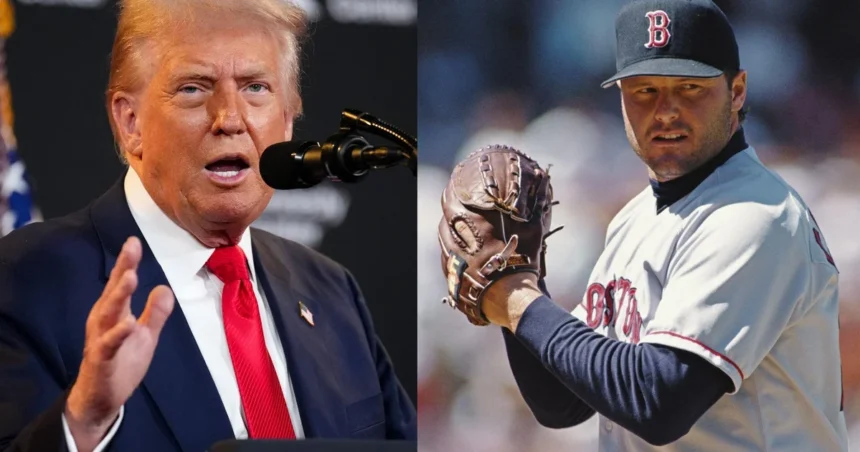
But just hours before the highly anticipated announcement of the Contemporary Baseball Era Players Committee inductees—a small, 16-member panel holding the fate of Clemens and Bonds—the entire debate was detonated by a voice from outside the dugouts. In a blistering, high-volume post on his social media platform, President Donald Trump weighed in with a demand that escalated the moral debate into a legal showdown.
His directive was simple, absolute, and profoundly destabilizing: Roger Clemens should not just wait for justice; he should “sue the hell out of Major League Baseball” if he is once again denied his place in the Hall of Fame.
The timing of this pronouncement was a masterstroke of political theater, a high-stakes intervention that treated a century-old sports institution like a contested courtroom. It recast the Hall of Fame debate—a quiet, often academic conflict among historians and journalists—as a grand-scale “Witch Hunt,” mirroring the political rhetoric of our polarized age. Trump’s comment, rooted in the undeniable fact of Clemens’ 2012 acquittal on charges of lying to Congress, draws an indelible line in the sand: the legal record must supersede the moral judgment of the press.
This blog post will dive deep into this unprecedented collision. We will analyze the historical greatness of Roger Clemens, dissect the impossible legal theory of suing the Hall of Fame, explore the fundamental philosophical rift between the judicial standard of proof and Cooperstown’s moral calculus, and contextualize this intervention within the broader landscape of politics and American culture.
Trump’s call to legal arms against the baseball establishment is more than just a defense of an ally; it is a profound challenge to the authority of private institutions to dispense public honors, forcing the game’s gatekeepers to justify their most contentious exclusions under the glare of national media and potential litigation. It’s a crisis point for the integrity clause, and a legal non-starter that is, nonetheless, a towering success as a cultural and political narrative.
II. The Rocket’s Hall of Fame Exile: A Tale of 354 Wins and a Single Report
To truly grasp the gravity of Roger Clemens’ situation and the force behind Trump’s defense, one must first look at the unparalleled brilliance of his career. It is not just the numbers that demand Hall of Fame enshrinement; it is the statistical rarity of his achievement.
The Indisputable Case for The Rocket
Roger “The Rocket” Clemens played for 24 seasons across four decades (1984–2007). His career statistics do not merely warrant a plaque; they place him on the absolute highest tier of pitching greatness, alongside legends like Walter Johnson, Cy Young, and Sandy Koufax.
- 7 Cy Young Awards: This is an all-time record, dwarfing the next closest pitchers (Randy Johnson, Steve Carlton, Greg Maddux) who have four. This award, given to the best pitcher in the league each year, is the definitive measure of pitching dominance, and Clemens won it in every uniform he wore: Boston, Toronto, and the Yankees/Astros.
- 354 Wins: This figure is ninth on the all-time list. In the modern era, where starting pitchers rarely complete games, this total is likely untouchable.
- 4,672 Strikeouts: This ranks third all-time, behind only the mythical Nolan Ryan and Randy Johnson.
- 2-time World Series Champion.
- 11-time All-Star.
- AL MVP (1986).
In a universe where the only criteria for the Hall of Fame were career accomplishments, Roger Clemens would have been a near-unanimous, first-ballot inductee in 2013, likely standing proudly next to his teammate, former Boston Red Sox shortstop Nomar Garciaparra, who instead received less than 6% of the vote.
The Shadow That Lingers: The Mitchell Report
The universe, however, is complicated by the specter of performance-enhancing drugs (PEDs). The exclusion of Clemens and Barry Bonds, the all-time home run leader, stems almost entirely from the 2007 Mitchell Report, an independent investigation commissioned by Major League Baseball that detailed the rampant use of illegal substances during the “Steroid Era.”
Clemens was prominently named in the report, primarily based on the testimony of his former strength and conditioning coach, Brian McNamee, who claimed to have injected Clemens with anabolic steroids and human growth hormone multiple times between 1998 and 2001.
This was not merely an accusation; it became a national scandal, leading to a televised congressional hearing in 2008 where Clemens vehemently denied the claims under oath, staring down the representatives and declaring his innocence. His public denial led to the criminal charges that would ultimately define the legal chapter of his career.
Legal Acquittal vs. Moral Conviction
This brings us to the crucial pivot point of Trump’s argument: the legal record. In 2010, Clemens was indicted on charges of perjury, making false statements, and obstructing Congress, all stemming from his testimony regarding the alleged PED use.
The subsequent federal trial was a ten-week media circus. In June 2012, a jury found Clemens not guilty on all six counts. This verdict was a legal triumph. The government failed to prove beyond a reasonable doubt that Clemens lied to Congress. Legally, the case was closed; Roger Clemens was vindicated in a court of law.
Yet, in the court of Cooperstown opinion, the case remains irrevocably open. When Clemens became eligible for the Hall of Fame via the Baseball Writers’ Association of America (BBWAA) ballot, the voters used the Hall of Fame’s own Rule 5—the notorious “character clause”—as a tool of prohibition:
“Voting shall be based upon the player’s record, playing ability, integrity, sportsmanship, character, and contributions to the team(s) on which the player played.”
For ten years on the BBWAA ballot, Clemens steadily gained support as the memories of the steroid era faded, peaking at 65.2% in his final year of eligibility (2022). That figure, while substantial, remained nearly ten percentage points shy of the required 75%. For the voters who denied him, the acquittal was irrelevant. They argued that the totality of evidence—the Mitchell Report, the public narrative, and the general suspicion surrounding the era—constituted enough moral failure to disqualify him from baseball’s ultimate honor. They were not bound by the standard of proof “beyond a reasonable doubt,” but rather by a historical, subjective, and intensely personal judgment of “character.”
When Trump demands Clemens “sue,” he is fundamentally demanding that the Hall of Fame submit to the judicial standard of proof, nullifying the moral authority of the character clause.
III. The Legal Quagmire: Can You Really Sue the Hall of Fame?
The central premise of Trump’s comment—that Clemens should seek redress in court—is legally fascinating but practically untenable. While the threat of litigation is an effective tool of public pressure, a successful lawsuit against the Hall of Fame over non-induction faces hurdles so numerous they amount to an unassailable legal wall.
Targeting the Wrong Entity: MLB vs. HOF
First, there is a fundamental jurisdictional problem with Trump’s instruction to “sue the hell out of Major League Baseball.”
The Hall of Fame, formally known as the National Baseball Hall of Fame and Museum, is a private, independent, non-profit educational institution located in Cooperstown, New York. It is not owned or operated by Major League Baseball (MLB), which is the league office headquartered in New York City. While MLB cooperates closely with the Hall, the voting process is controlled by the BBWAA (a separate professional organization) and the Era Committees (comprised of Hall of Famers, executives, and select journalists).
Clemens would have to sue the National Baseball Hall of Fame and Museum or, perhaps, the specific members of the Contemporary Baseball Era Players Committee and their governing bodies. Suing MLB directly would likely result in an immediate dismissal for failure to state a claim against the correct party.
Lack of Legal Standing: Privilege, Not Right
The most devastating blow to any potential lawsuit is the concept of “legal standing” and the nature of the award itself.
Hall of Fame induction is considered a non-contractual, non-guaranteed honor, a privilege, not a right of employment. A player is not contractually entitled to be honored simply by meeting statistical thresholds. The Hall of Fame Charter grants the BBWAA and the Era Committees the absolute discretion to set the standards and interpret the character clause.
For a court to intervene, Clemens would have to demonstrate a legally cognizable injury. What damage could he claim?
- Breach of Contract: Impossible, as no contract exists for induction.
- Defamation/Slander: This is where the acquittal seems strongest, but even this is weak. Clemens was acquitted of lying about steroid use, not of the steroid use itself. Furthermore, the voters are judging the historical record and acting within their chartered discretion to apply the “character” rule. To sue for defamation, he would have to prove:
- The HOF or a committee member published a false statement of fact.
- The publication caused actual damage.
- The statement was made with actual malice (i.e., they knew it was false or acted with reckless disregard for the truth).
- Since the HOF is a private institution interpreting a subjective criterion (“character”) based on publicly available (though contested) reports (the Mitchell Report), the denial itself is likely protected as an opinion or judgment based on the totality of historical evidence, not a simple statement of false fact.
- Restraint of Trade/Monopoly: Baseball has a unique, though eroding, protection in the form of its antitrust exemption, established by the 1922 Supreme Court case Federal Baseball Club v. National League and reaffirmed in Toolson v. New York Yankees (1953) and Flood v. Kuhn (1972). While this exemption primarily covers the league’s business structure and labor issues, it established a long precedent of judicial deference to baseball’s internal workings. A lawsuit about HOF denial is unlikely to gain traction on antitrust grounds, as Clemens is retired and the exclusion does not hinder his present ability to earn a living in the labor market.
The Precedent of Judicial Reluctance
The law has historically refused to intervene in subjective disputes over honors, awards, and membership in private associations. For instance, courts rarely interfere with the membership decisions of private clubs, professional societies, or, indeed, the awarding of academic degrees, unless the decision clearly violates the association’s own explicit, non-subjective rules, or is the result of illegal discrimination (e.g., race or gender). The “character clause” is the ultimate escape hatch for the Hall of Fame—it is a subjective, amorphous standard that allows voters to exercise moral discretion, a discretion courts are loath to review.
In essence, Trump’s call to “sue” is a powerful emotional and political rallying cry, but in the halls of justice, it would be a motion destined for the scrap heap of unviable litigation. The victory he seeks is rhetorical, not legal.
IV. The Voting Paradox: Acquit vs. Immortalize
The crux of the Hall of Fame debate, and the reason for the political intervention, lies in the fundamental philosophical difference between a criminal court and an historical museum. Trump and his supporters argue for the supremacy of the former; the Hall of Fame electorate defends the autonomy of the latter.
The Shifting Sands of Cooperstown Governance
Clemens’ journey to the Contemporary Baseball Era Players Committee ballot is itself a story of institutional flux. After exhausting his ten years on the BBWAA ballot, he moved to the Veterans Committee system, which the Hall of Fame has continually restructured to manage the backlog of deserving, but controversial, candidates.
The Contemporary Baseball Era Players Committee, in place for the current vote, consists of 16 individuals—a mix of Hall of Famers, executives, and media members. This small size means every single vote holds immense weight. A player must receive 75% support, meaning 12 of 16 votes. The small size and the composition (which often includes players or executives who may have a more “performance-first” mentality) was seen as the best chance for Clemens and Bonds to finally break through.
However, the previous Era Committee ballot saw both men receive fewer than four votes, a clear signal that the zero-tolerance stance of the writers had been internalized by the committees as well.
The Character Clause: A Moral Gauntlet
The voters—whether writers or committee members—are tasked with defining the integrity of the game. When they choose to exclude Clemens, they are operating under a standard far removed from the legal standard of proof.
- Court of Law Standard: Beyond a reasonable doubt. The jury must be nearly certain that Clemens lied to Congress to convict him. The prosecution failed to meet this high bar, leading to the acquittal.
- Hall of Fame Standard: Totality of the historical record. Voters believe their mandate is to enshrine role models who embodied “integrity.” The suspicion of PED use, the naming in the Mitchell Report, the public hearing, and the surrounding controversy—all of this constitutes enough doubt to fail the “character” test, regardless of the judicial outcome.
The distinction is critical. A criminal acquittal simply means the state could not prove guilt in a specific context (lying to Congress). It does not mean the underlying allegation (PED use) was proven false. For many voters, Clemens’ statistical dominance in the heart of the steroid era, coupled with the testimony against him, is proof enough that his career benefited from illicit means, thus violating the spirit of the game.
The Four Voting Blocs and the Barrier of the Past
The electorate is often divided into four philosophical blocs when addressing the steroid era:
- Bloc 1: The Zero-Tolerance Absolutists: These voters adhere strictly to the character clause. Any strong link, even unproven in a court of law, disqualifies the player. This group holds immense power, as they effectively raise the 75% bar to 100% of the remaining, non-absolutist voters.
- Bloc 2: The Definitive Link Pragmatists: These voters require an MLB suspension, a positive test, or an official admission. Since Clemens never tested positive and was never suspended by MLB, this group is often split, leaning either toward or away from him based on the strength of the Mitchell Report testimony.
- Bloc 3: The Performance-Only Advocates: This group believes the Hall of Fame’s purpose is to document the greatest players of an era, including those who cheated. They argue that PEDs were endemic, and excluding the greatest players (Bonds, Clemens) creates a vast historical gap.
- Bloc 4: The Historical Contextualists: These voters analyze the player’s performance before and after the alleged use. Clemens had a legendary career before the alleged timeline, which helps his case compared to others.
Trump’s intervention is designed to empower Blocs 3 and 4 while framing Bloc 1 as the biased, unjust “establishment.” By demanding a lawsuit, he is effectively trying to force the Zero-Tolerance voters to submit to an external, higher authority: the federal judiciary. When the Hall of Fame inevitably ignores this directive, they confirm, in the eyes of Trump’s supporters, their status as an unjust, politically motivated cabal.
V. The Political Playbook: Trump, Clemens, and the Culture Wars
Donald Trump’s willingness to insert himself into the Roger Clemens Hall of Fame debate is not an isolated incident; it is a calculated execution of a political playbook that treats institutional exclusion as a form of persecution.
The “Witch Hunt” Narrative in Sports
Trump’s use of the term “Witch Hunt” to describe the plight of Roger Clemens immediately aligns the former pitcher’s struggle with Trump’s own political defense. The core of this narrative is the assertion that powerful, unelected elites (in this case, the BBWAA and the Era Committee, often described by critics as a cloistered cabal of journalists and former adversaries) are unjustly targeting a great American figure based on “rumors and innuendo,” despite being acquitted in a real court of law.
This framing is highly effective because it bypasses the nuanced, difficult moral analysis of the steroid era and replaces it with a simple story of institutional abuse:
- Victim: Roger Clemens (The acquitted, statistical champion).
- Perpetrator: The Baseball Establishment (The biased, moralizing gatekeepers).
- Proof of Injustice: The denial of induction despite an acquittal.
By casting Clemens’ Hall of Fame snub as a political injustice rather than a historical judgment, Trump mobilizes a vast segment of the public who distrust elite institutions and sympathize with figures who feel wrongly targeted. The exclusion, therefore, stops being about baseball history and starts being about a cultural power struggle.
The Pete Rose Precedent: Overturning Moral Bans
Trump’s defense of Clemens is consistent with his previous interventions into baseball’s most sacred controversies. He has long advocated for the induction of Pete Rose, baseball’s all-time hits leader, who was banned from the game for life in 1989 for betting on games while managing the Cincinnati Reds.
Trump’s posts on Rose, which compared him to Clemens, focused on the injustice of a great player being denied his legacy by an overly moralizing Commissioner (Rob Manfred) or a stubborn institution. The theme is the same: the punishment, often stemming from moral or character failings, outweighs the accomplishments, and this imbalance must be rectified by external pressure.
The ultimate goal of both the Rose and Clemens interventions is to redefine the criteria for immortality. Trump argues that sheer, unadulterated performance—354 wins, 7 Cy Youngs, or 4,256 hits—must be the sole metric, and that the subjective “character clause” is an unjust tool of political correctness used by elites to police behavior rather than celebrate achievement.
The Strategy of Litigation as Public Relations
Perhaps the most ingenious aspect of the “sue MLB” strategy is that it is a public relations masterstroke disguised as legal advice. Trump is highly familiar with using legal threats not to win in a courtroom, but to dominate a news cycle and intimidate adversaries.
By publicly instructing Clemens to “sue the hell out of” the league, he accomplishes several goals instantaneously:
- Forces a Response: The Hall of Fame is an independent entity that prefers to operate quietly. A threat of a major federal lawsuit—even an unwinnable one—forces the institution to potentially issue statements, consult lawyers, and deal with massive negative publicity.
- Creates Leverage: It provides Clemens and his advocates with a massive national platform and an aggressive narrative to use for future committee votes.
- Shifts Blame: It places the responsibility for the ongoing “Witch Hunt” squarely on the Hall of Fame’s doorstep, suggesting that they are engaging in illegal, actionable behavior by refusing to honor a legally acquitted man.
The threat of litigation here is the point, not the litigation itself. It injects a level of chaos and external aggression into the Cooperstown process that is entirely unprecedented, ensuring that Clemens’ rejection, if it occurs, is viewed not as a historical consensus, but as a deliberate act of institutional discrimination against an innocent man.
VI. The Aftermath and Future Implications: A New Hurdle for Cooperstown
The fallout from Trump’s comment reveals a major paradigm shift in how sacred American institutions are challenged. The National Baseball Hall of Fame must now grapple not only with the lingering moral stain of the steroid era, but also with the direct, aggressive intrusion of political culture into its induction process.
The Post-Acquittal Dilemma
The core of the matter remains: What is the relationship between the rule of law and the award of an honor?
For many Americans, particularly those who rally behind the banner of fighting “establishment” corruption, the judicial acquittal is the definitive, final truth. Clemens was found not guilty, therefore, he is innocent and deserving of the Hall. To deny him is to deny the outcome of a federal court proceeding, which feels fundamentally un-American.
For the Hall of Fame, the denial of Clemens (and Bonds) is a desperate, yet highly criticized, attempt to maintain the purity of the historical record. They fear that enshrining players who are believed to have chemically altered their performance would permanently devalue all records and dilute the honor of the bronze plaque. If Clemens were inducted, the character clause, which is fundamental to the Hall’s mission statement, would effectively cease to exist.
The Unanswered Question of the Vote
Regardless of whether Clemens was successful in the recent Contemporary Baseball Era Committee vote (given the low support in previous committee voting, a failure is highly probable), the political pressure remains a permanent fixture.
If Clemens fails, Trump’s prophecy—the injustice—is fulfilled, fueling the narrative of a biased system and potentially paving the way for the threatened, yet futile, lawsuit.
If, against all odds, Clemens had managed to secure the 12 votes necessary for induction, the moment would be forever asterisked. His plaque would not be seen as a consensus of baseball greatness, but rather as a capitulation to political and public pressure, confirming the fear among traditionalists that the Hall of Fame’s independence has been compromised.
The End of Institutional Autonomy
The Roger Clemens/Donald Trump episode is a microcosm of a larger societal trend: the refusal of powerful political voices to respect the traditional autonomy of non-political institutions.
For decades, the Hall of Fame operated in a secluded, self-governing world. Its elections were heated, but the arguments remained within the boundaries of baseball statistics, historical context, and the meaning of “character.” Now, the argument has been pulled out of the library and into the political arena.
The legacy of this moment is that the Hall of Fame is no longer just a museum; it is a battleground. Any future denial of a high-profile, scandal-plagued player—whether it be a steroid user, a sign-stealing executive, or a controversial manager—will now come with the implicit threat of external, aggressive intervention.
The message is clear: the elite custodians of American history, whether they are sports writers, museum executives, or political commentators, cannot police character without being branded as participants in a “Witch Hunt.”
VII. Conclusion: Cooperstown’s Defining Challenge
The debate over Roger Clemens has always transcended baseball. It is a defining cultural query about forgiveness, justice, and the criteria for historical greatness. The man who won a record seven Cy Young Awards, was found not guilty in a court of law, yet still remains on the outside of Cooperstown, embodies the struggle between legal truth and moral suspicion.
Donald Trump’s aggressive intervention to demand that Clemens “sue the hell out of MLB” does not offer a viable legal path; it offers a potent political one. It challenges the Hall of Fame, an institution built on quiet historical contemplation, to justify its moral standards against the louder, simpler argument of statistical dominance and legal acquittal.
The result is a permanent shift in the dynamic of baseball’s most sacred honor. The Hall of Fame can no longer rely on the quiet consensus of the press box. It must now defend its “character clause” from the looming threat of political pressure and legal confrontation. While the doors to the courtroom will almost certainly remain shut to Clemens, the doors to the media spotlight have been blown wide open, ensuring that the legacy of The Rocket and the integrity of Cooperstown will remain intertwined in a contentious and unresolved debate for years to come.