AI will not replace humans, but those who use AI will replace those who don’t. – Ginni Rometty
The year 2026 marks a pivotal shift in how we interact with technology. Artificial Intelligence is moving beyond the cloud and integrating directly into the devices we touch every day, transforming them from mere tools into intuitive, predictive partners. This isn’t the distant, theoretical AI of science fiction; this is Edge AI, intelligence that lives right on your phone and within the walls of your home. It’s faster, more personalized, and fundamentally changes the way we live, work, and connect. For the modern consumer, understanding this transition is key to unlocking a future of seamless, hyper-personalized experiences.
In this deep dive, we will explore the three central concepts driving this revolution: the rise of the AI Phone, the evolution to the Intelligent Home, and the shift toward Multimodal and Agentic AI that acts on your behalf. Prepare to meet the new, smarter versions of the devices you thought you already knew.
The Rise of the AI Phone: Your New Intelligent Companion
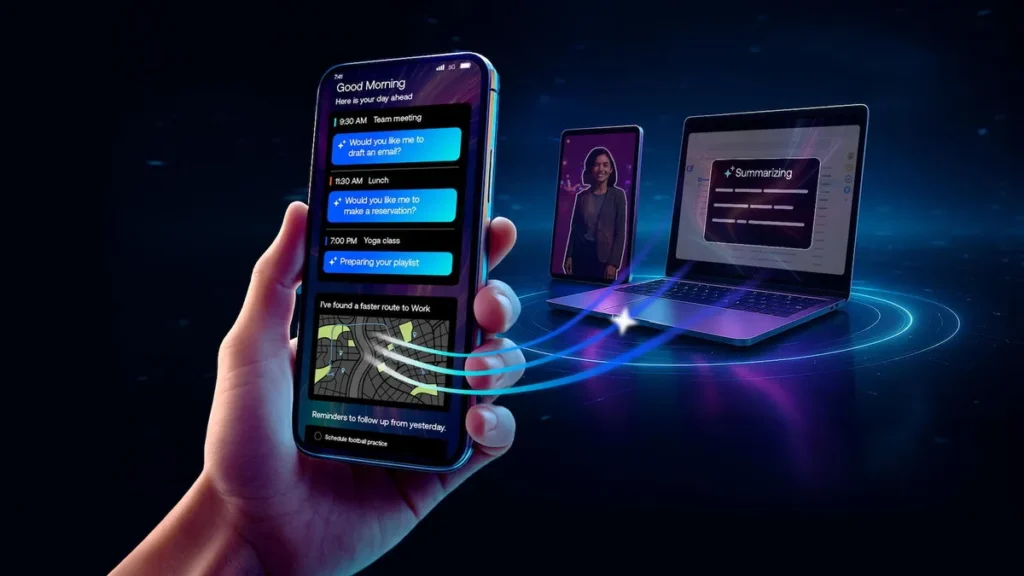
For years, smartphones relied on cloud servers to handle complex AI tasks like language processing and image generation. That dependency is fading. In 2026, the power of Artificial Intelligence is embedded directly into the phone’s processor, facilitated by specialized components known as Neural Processing Units (NPUs). This move to “on-device AI” creates a smartphone experience that is faster, more private, and infinitely more personal.
1. On-Device Intelligence: Speed, Privacy, and Efficiency
The biggest upgrade in 2026 smartphones is the move toward Edge AI. New flagship processors, such as the Google Tensor G5 and Qualcomm Snapdragon chips, are optimized for this shift.
Real-time Responsiveness: Tasks that once required a delay to communicate with the cloud now happen instantly. Think about live language translation, complex photo editing, or the instant summary of a long document all happening on the device without a stutter. Arm’s new Lumex platform, for example, promises up to a 5x improvement in AI performance with lower latency for speech-based workloads, making tools like real-time yoga-tutor feedback possible.
Enhanced Privacy: By performing AI tasks locally, your sensitive data, such as your photos, voice recordings, and location history, never leaves your phone. This fundamental security shift is a major selling point for premium devices in the new era.
Battery Optimization: The new generation of AI processors is designed for extreme power efficiency. Running complex AI models on the local NPU is often less taxing on the battery than constantly communicating with the cloud over a 5G network.
2. Generative AI Goes Mobile: Creativity in Your Pocket
Generative AI (GenAI), which creates new content from prompts, is no longer limited to desktop browsers.
AI Camera Coach and Generative Edit: Future smartphones will incorporate AI to not only enhance photos after they are taken but also to advise you before you press the shutter. An AI Camera Coach might suggest a better angle or lighting adjustment in real-time. Post-capture, features like Generative Edit will offer powerful, one-tap manipulation, such as seamlessly removing large objects or changing the time of day in a photo, adapting flexibly with impressive scale.
Multimodal AI for Everyday Tasks: Devices are becoming multimodal, meaning they can process and generate content across text, images, and audio simultaneously. Imagine showing your phone a picture of a broken part, speaking a question about fixing it, and having the AI instantly provide step-by-step instructions, complete with generated visual aids. Samsung’s Galaxy AI, enhanced with multimodal capabilities, is focusing on this kind of intuitive, contextual assistance.
AI-Driven Organization: Your phone’s operating system will learn your usage patterns on a deep, predictive level. It will automatically prioritize notifications, organize emails into categories you didn’t even know you needed, and proactively suggest apps or information based on your current location and time of day, making the interface feel almost invisible.
From Smart Home to Intelligent Home in 2026
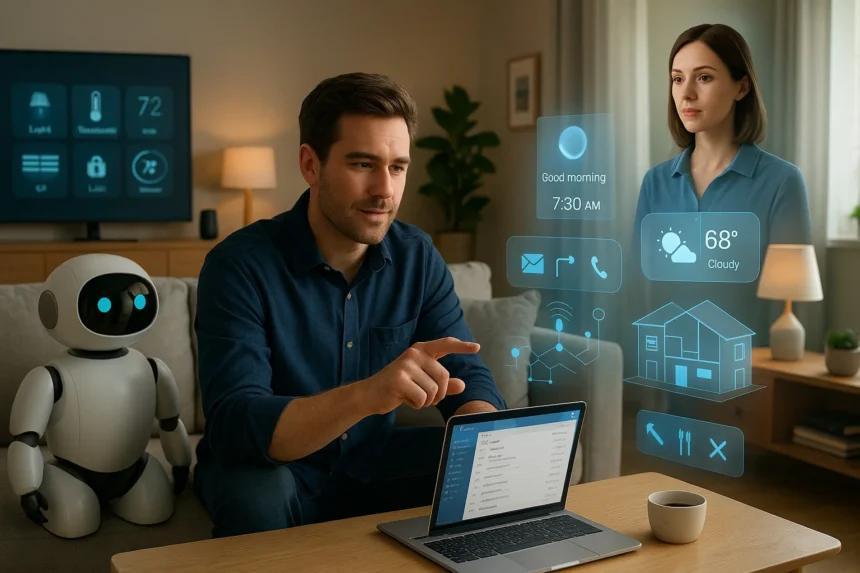
The “Smart Home” of yesterday was a collection of connected devices that merely responded to commands: “Turn off the lights.” The “Intelligent Home” of 2026 is a system that anticipates needs, makes decisions, and runs itself autonomously. This is achieved by weaving sophisticated, context-aware AI into the very fabric of the home.
1. Predictive Home Automation and Ambient Computing
The shift from reactive to predictive is the key difference in smart home technology for 2026.
Anticipatory Climate Control: Instead of merely learning your preferred temperature, AI-powered thermostats will factor in local weather forecasts, real-time household occupancy, window and door status, and even your personal activity level (tracked via wearables) to adjust the climate before you feel uncomfortable. This saves energy and enhances comfort seamlessly.
Whole-Home Voice Control: Voice assistants are evolving into an Ambient Computing layer. Built directly into walls, appliances, and TVs, systems like “Gemini for Home” will enable continuous, natural conversation without the need for constant wake-up phrases like “Hey Google.” The AI will understand context and spatial awareness, knowing which room you are in and which device you are referring to.
Smarter Energy Management: The Intelligent Home actively participates in sustainability. AI systems will use solar forecasting and dynamic load balancing to automatically run high-consumption appliances (like dishwashers or washing machines) during off-peak utility hours or when solar power generation is highest. One estimate suggests AI-run smart homes could reduce household $\text{CO}_2$ consumption by up to 40 percent.
2. AI for Health, Wellness, and Security
The home is becoming a primary health monitor, silently and seamlessly tracking wellness metrics.
Circadian Lighting Systems: AI-controlled lighting adjusts color temperature and intensity throughout the day to support your natural circadian rhythm. Bright, cool white light in the morning for alertness, and dim, warm light in the evening to promote melatonin production and better sleep.
Proactive Security Agents: Home security moves beyond simple motion detection. AI-powered security cameras use machine learning to detect unusual or “agentic” behavior, not just movement. The system can recognize the difference between a falling package and an attempted break-in, a familiar face, or a stranger, providing fewer false alarms and faster, more accurate threat alerts.
The Rise of Domestic AI Robots: The launch of next-generation home companions, like Samsung’s Ballie, points toward a future where AI robots navigate your home, monitor pets, control smart devices, and act as a functional, mobile assistant, essentially serving as a physical manifestation of your smart home’s central intelligence.
The Paradigm Shift: Agentic AI and the Human Loop
The most significant, yet often overlooked, trend for 2026 is the emergence of Agentic AI. This is the leap from AI that simply responds to a prompt (like a chatbot) to AI that plans, initiates, and executes multi-step tasks autonomously to achieve a long-term goal.
1. From Assistants to AI Agents
Agentic AI systems are designed to coordinate complex workflows across multiple applications and services.
Autonomous Task Execution: Instead of asking an AI to “Draft an email about the project deadline,” you can simply delegate a long-term goal: “Research and book the entire business trip to Paris, including flights, hotels, and scheduling meetings with clients.” The AI agent then autonomously breaks this down into sub-tasks, interacts with travel sites, compares prices, checks your calendar, and presents a finalized, optimized itinerary for your approval.
Inter-Agent Communication: Different specialized AI agents from various software platforms will begin communicating with each other. For example, your personal finance AI agent could negotiate with your utility company’s customer service AI agent for a better rate, all without your direct involvement, creating a truly automated workflow.
The AI in the Human Loop: This technology is not about replacement; it’s about augmentation. The goal is to move into a new era of AI in the human loop, where the AI handles the administrative, time-consuming tasks, freeing you up to focus on creativity, decision-making, and high-value work.
2. Multimodal AI Redefines Interaction
The power of multimodal AI is its ability to understand the world through combined sensory inputs, mirroring human cognition.
Contextual Awareness: The combination of on-device camera vision, microphone audio, and text input allows the AI to understand complex, real-world context. Hold up a prescription bottle, ask your phone what the side effects are, and the AI processes the image and the question to provide an instant, accurate summary.
Hyper-Personalization in Entertainment: Generative AI is moving beyond recommendations to actively shaping the content itself. In video games, for example, Non-Player Characters (NPCs) will have realistic, unscripted personalities that adapt dynamically to a player’s unique actions, making every game session a unique, personalized narrative co-created by the user and the AI.
Here is an interesting and trending video that perfectly aligns with our topic of AI in everyday devices:
The Ethics and Infrastructure Challenge
While the benefits are transformative, the widespread integration of Edge AI presents two major challenges that shape the 2026 landscape:
Data Stewardship and Privacy: Since AI is processing highly personal data locally, manufacturers must commit to rigorous transparency. Consumers will demand to know exactly when AI is making decisions, what data is collected, and how it is used. The concept of Secure-by-Design, where encryption and privacy are built into the hardware, is a necessity.
The AI-Energy Nexus: The massive, global scaling of AI requires immense computational power, leading to concerns about energy and water consumption by data centers. The industry is responding with a drive toward hyper-efficient chips and a push for integrated resource strategies that couple AI growth with sustainability, ensuring the technology’s long-term social license to operate.
Live Daily Information: Embracing the AI Future
To stay ahead of the curve in this rapidly evolving AI landscape, integrate these simple checks into your daily routine:
Daily Device AI Feature Check: Note one new AI-powered feature you used on your phone today (e.g., a better photo suggestion, an auto-transcribed voice note, a perfect text prediction). This fosters appreciation for the technology’s subtle power.
Intelligent Home Energy Audit: Use your smart thermostat or utility app to check your home’s energy consumption against the predictive forecast. See if the AI’s automation saved you money today compared to your average use.
AI Agent Delegation: Identify one small, time-consuming task you can delegate to a large language model or an early-stage AI agent (e.g., “Summarize the top three news stories about the stock market” or “Draft a polite reminder email”).
Privacy Audit: Check the privacy settings on your most-used AI-enabled apps. Ensure you understand what data is being processed locally (Edge AI) versus what is being sent to the cloud.
Conclusion: Your AI-Augmented Life
The transition to AI-powered phones and intelligent homes in 2026 is not an evolution of hardware, but an evolution of experience. It is about technology fading into the background, working autonomously to enhance your life, boost your productivity, and protect your well-being. By moving intelligence to the Edge, devices gain speed and privacy, while the home evolves into an intuitive, predictive servant. The key takeaway is simple: embrace these tools. Learn to delegate tasks to your new AI agents. Leverage the on-device intelligence for better photography, faster communication, and a more sustainable, comfortable living environment. The future is here, and it is a partnership between human ingenuity and artificial intelligence.